

What’s the Top High Voltage Battery for Long-Range UAV Missions?
Long-range UAV missions don’t leave much margin for error. You’re flying further from base, often without recovery options if something goes wrong mid-route, and the battery keeping your aircraft airborne is doing more work over a longer period than any short-range inspection or mapping job demands.
The battery question for long-range operations isn’t just “which has the most capacity.”
It’s which battery can sustain consistent performance across an extended discharge, handle the thermal load of a long flight, and deliver enough usable energy — at the pack level, after weight is accounted for — to make the mission viable in the first place.
High voltage configurations are typically where the answer lives. Here’s why, and what to look for.

Почему High Voltage Wins for Long-Range Work?
The physics behind top high voltage battery for UAV favoring endurance applications comes down to efficiency.
At higher voltage, motors produce the required thrust at lower current. Lower current means less resistive loss in wiring, ESCs, and motor windings — more of the energy stored in the pack actually moves the aircraft rather than generating heat.
On a 20-minute urban inspection flight, that efficiency difference is marginal. On a 90-minute corridor survey or long-range delivery route, it compounds into meaningful additional flight time.
6S (22.2V nominal) has become the standard for serious commercial endurance platforms for exactly this reason.
8S and 12S configurations appear on heavier industrial aircraft where payload requirements push power demands beyond what 6S handles efficiently.
The right configuration depends on your platform’s power system design — the motor KV rating and ESC voltage ceiling define your ceiling.

The Specs That Matter Most for Long-Range Missions
Плотность энергии at the pack level. This is the most important number for range extension and the most frequently misrepresented.
Cell-level energy density figures look impressive. Pack-level figures — which account for BMS, housing, connectors, and structural weight — are what determines actual flight performance.
For long-range missions, every gram of non-productive battery weight is range you’re not flying. Demand pack-level Wh/kg from any supplier you’re evaluating.
Discharge curve flatness. A battery that maintains consistent voltage across 80% of its discharge and then drops sharply is more useful for long-range work than one that sags progressively from the start.
Flat discharge behavior means predictable performance throughout the mission rather than degrading responsiveness in the final third of the flight.
Low internal resistance. Internal resistance determines how much top high voltage battery drops under load. High internal resistance in a long-range battery means the pack underdelivers at the current draw your platform requires, even if the nominal capacity is sufficient.
This matters more on extended flights than short ones because the cumulative energy lost to resistance is larger.
Thermal behavior across the full discharge. A 90-minute flight produces more thermal load than a 20-minute one.
Batteries that run progressively hotter as they discharge — common in lower-quality packs — are delivering degrading performance throughout a long mission and accumulating thermal damage faster than their cycle ratings assume.
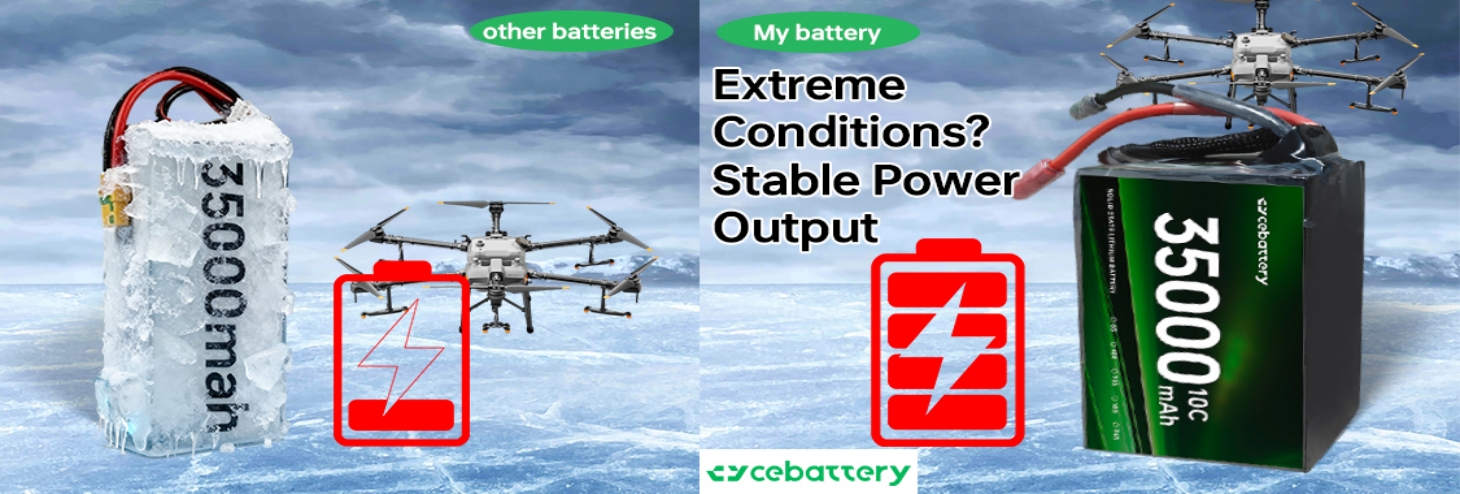
Solid-State vs. High-Performance LiPo for Long Range
This is where the choice gets genuinely interesting for long-range operators.
Advanced lithium polymer batteries in high-voltage configurations remain the dominant choice for most long-range commercial platforms today — proven, available, and cost-effective at scale.
The best high-voltage LiPo packs from quality manufacturers deliver strong pack-level energy density, reliable discharge curves, and cycle life suitable for commercial duty cycles.
Solid-state lithium-ion batteries offer a real energy density advantage over LiPo at the pack level, which translates directly into range extension for equivalent battery weight.
For platforms where the power system is already optimized and range is the remaining constraint, the solid-state premium often justifies itself in operational terms.
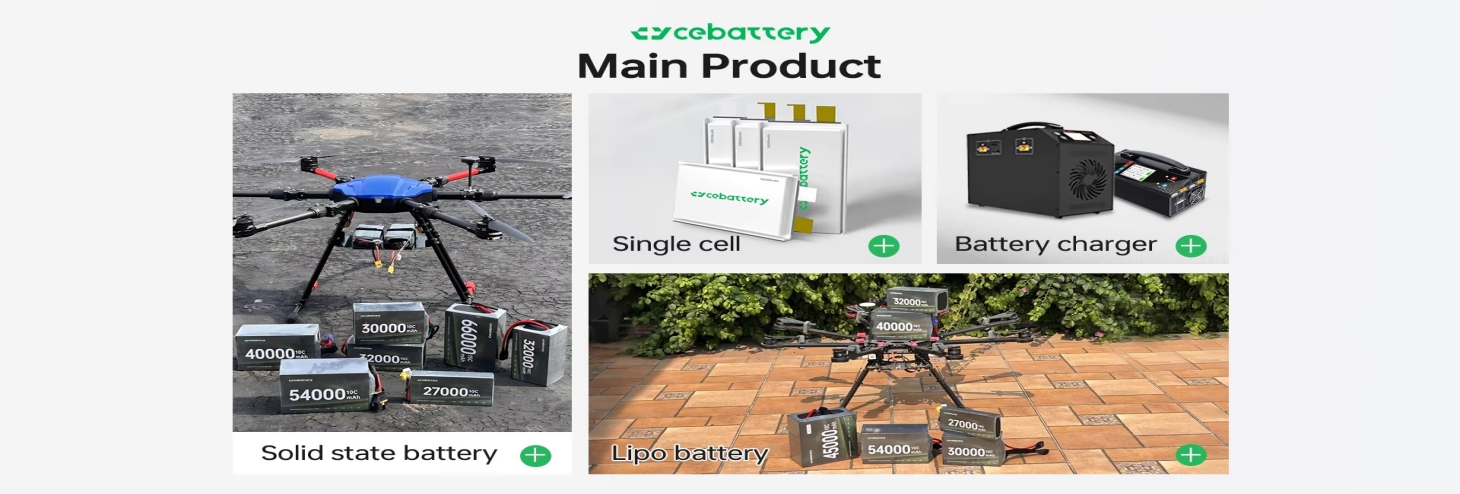
What CEBATTERY Builds for This Application?
CEBATTERY engineers high-voltage lithium polymer and solid-state lithium-ion UAV batteries specifically for commercial and industrial drone applications — including long-range platforms where energy density, discharge consistency, and thermal management aren’t optional features.
The development cycle for the company’s new products only takes 3 to 7 days. Currently, the annual sales volume has covered regions such as Europe, America, the Middle East, and Southeast Asia.
The top high voltage battery for long-range UAV missions isn’t a single product. It’s the configuration that matches your platform’s power system, payload weight, and mission profile — built to a manufacturing standard that delivers what the spec sheet promises in actual field conditions.
That combination is what CEBATTERY is built to provide.

- Meet CEBATTERY at the 2026 Shanghai Low-altitude Economy Expo
- What’s the Top High Voltage Battery for Long-Range UAV Missions?
- Solid State vs Lipo Battery—Which Delivers Better UAV Safety and Life Cycle?
- Why Original Factory Batteries Outperform Cheap Generic Options?
- How to Match UAV Power Needs with the Right High Voltage Pack