

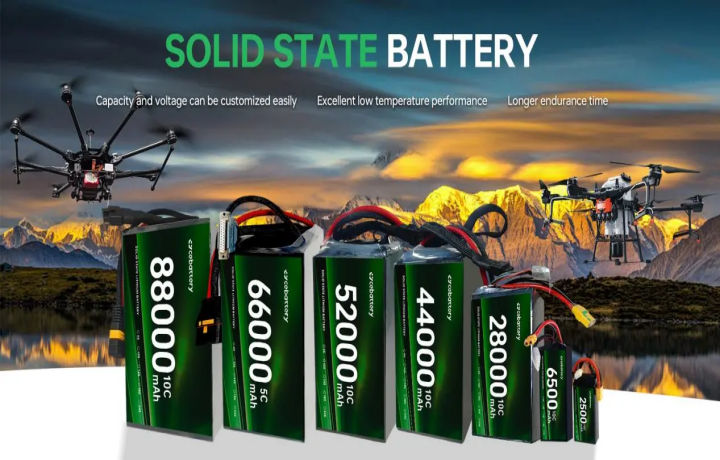
Drone Battery, as applications expand from aerial photography to industrial inspections and emergency response, understanding how drone batteries work—and what makes them unique—is essential for optimizing performance.
- Enhanced Safety: The solid electrolyte eliminates the risk of leakage and reduces the likelihood of thermal runaway, making these batteries significantly safer.
- Increased Energy Density: High energy density solid state batteries can store more energy in a smaller space, potentially doubling the energy density of current lithium-ion batteries.
- Improved Stability: Solid electrolytes are less reactive and more stable across a wider temperature range, enhancing overall battery performance and longevity.
- Faster Charging: The solid-state drone battery design allows for quicker ion transfer, potentially reducing charging times dramatically.
- Extended Lifespan: With reduced degradation over time, solid state batteries can endure more charge-discharge cycles, lasting longer than their liquid-electrolyte counterparts.
During operation, lithium ions move through the solid electrolyte from the cathode to the anode during charging, and vice versa during discharging. This process is similar to that in traditional lithium-ion batteries, but the solid electrolyte enables more efficient and stable ion transfer.

Why Materials Set the High Energy Density Limit in Solid-State Batteries
Solid-state batteries (SSBs) are revolutionizing energy storage by delivering 2-3× higher energy density than traditional liquid lithium-ion batteries. This breakthrough stems from fundamental advantages in materials, voltage windows, and electrode design.
Energy density is a critical measure that reflects how much energy a battery can store relative to its weight or volume. Understanding this fundamental metric is essential to appreciating why solid-state batteries represent such a significant advancement.
Two Types of Energy Density
Gravimetric Energy Density (Wh/kg): Energy per unit weight — critical for electric vehicles and portable devices where weight matters
Volumetric Energy Density (Wh/L): Energy per unit volume — important for compact applications like smartphones and laptops
Solid-state batteries excel at both metrics, offering improvements in weight-to-energy and volume-to-energy ratios simultaneously.
Solid electrolytes, by contrast, bring several advantages that directly impact energy density:
Advantages of Solid Electrolytes

Safer, Non-Flammable Environment: Eliminates fire risk from liquid organic solvents
Wider Electrochemical Stability Windows: Can operate at 5-6V+ without decomposition
Enables Lithium Metal Anodes: Mechanically blocks dendrite growth, unlocking 10× higher capacity
Enhanced Interface Stability: Reduces side reactions that degrade electrode materials
Comparable Ion Transport: Advanced materials like sulfides achieve 10⁻³ to 10⁻² S/cm conductivity
Wider Temperature Range: Operates from -40°C to 70°C.
One big reason solid-state batteries (SSBs) drone battery pack more energy is their ability to operate at higher voltages. Traditional liquid electrolytes hit a wall around 4.2 volts — beyond that, they start to break down and pose safety risks like flammability. This limits the maximum voltage and, in turn, the energy density you can get from the battery.
Solid electrolytes change the game. Materials like sulfides, oxides, and polymers offer a much wider electrochemical stability window, often up to 4.5 volts. This means you can push cell voltage higher without worrying about electrolyte decomposition or safety.
An advantage: solid electrolytes are inherently non-flammable, drastically reducing thermal runaway risks seen in conventional liquid lithium-ion batteries. This safety boost makes solid state batteries especially attractive for drones and robots.
Future trends in drone energy systems:
- Solid-State Batteries: Safer, higher-capacity alternatives to lithium-ion, with potential to double flight times.
- Solar Hybrid Systems: Integrated solar panels recharge batteries mid-flight, ideal for long-endurance surveillance missions.
- AI-Optimized Charging: Machine learning predicts usage patterns to pre-condition batteries for specific tasks, improving efficiency by 20–30%.