FPV Drone Battery for Racing: 5 Features That Win Competitions
In the world of professional FPV racing, victory isn’t measured in minutes—it’s measured in milliseconds. You can have the most expensive frame and the fastest motors, but if your power source can’t keep up, you’re just a fast-moving brick.
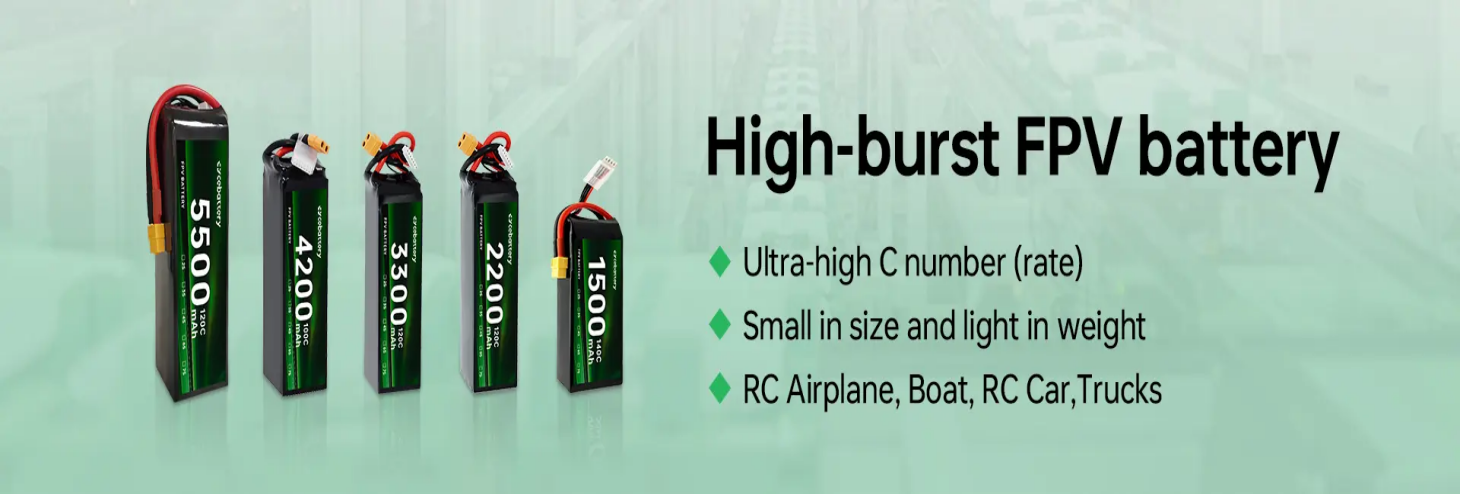
Choosing the right FPV drone battery for racing is often the “secret sauce” that separates the podium finishers from the rest of the pack. It’s not just about capacity; it’s about how that energy is delivered when you’re pushing the sticks to the limit.
Here are the five essential battery features that will give you the competitive edge in your next heat.
- Ultra-High Discharge Rate (C-Rating)
If you’ve ever felt your drone “get mushy” during a punch-out at the end of a straightaway, you’ve experienced voltage sag. In racing, you need a battery with a massive C-rating.
While freestyle pilots might be happy with 75C or 100C, competitive racers look for 120C to 150C continuous discharge rates. A high C-rating ensures that when you demand full throttle to clear a gate or recover from a sharp turn, the battery delivers the current instantly without the voltage dropping. This “punch” is what allows you to maintain consistent speed from the first lap to the last.
- The LiHV Advantage: Higher Initial Voltage
Standard LiPo batteries charge to 4.2V per cell. However, many top-tier racing packs are now LiHV (High Voltage Lithium Polymer), which can be safely charged to 4.35V per cell.
That extra 0.15V per cell might seem small, but on a 6S setup, that’s an extra 0.9V at the start of the race. This gives you a higher top-end speed and more “oomph” during the critical first 30 seconds of a heat where positions are often decided. Just ensure your charger and ESCs are rated for the extra voltage!
- Optimized Weight-to-Power Ratio
In racing, weight is the enemy of agility. A common mistake is flying a battery with too much capacity (mAh), thinking more flight time is better. In reality, a heavier battery makes the drone harder to stop and slower to rotate.
The goal is to find the “Sweet Spot” capacity. For most 5-inch racing builds, this usually lands between 1100mAh and 1300mAh. You want just enough juice to finish 3-4 laps at 100% throttle with about 20% remaining. Carrying an extra 50 grams of “safety margin” will only slow down your lap times.
- Low Internal Resistance (IR)
Internal Resistance is the silent killer of performance. It is a measure of how much the battery resists the flow of current. The lower the IR, the more efficiently the battery operates.
Batteries with high IR generate more heat and lose more energy as wasted thermal output rather than kinetic power. When shopping for an FPV drone battery for racing, look for “matched cells.” Premium manufacturers test each cell to ensure they have nearly identical, ultra-low IR. This ensures the pack drains evenly, preventing one “weak cell” from triggering your low-voltage alarm prematurely.
- Durable, Low-Profile Packaging
Racing is a contact sport. You’re going to hit gates, and occasionally, other pilots. A battery that survives a crash is just as important as one that wins a race.

Look for packs that feature:
Reinforced heat shrink: Extra layers to prevent punctures.
Internal plate protection: To avoid denting, many racing packs now have thin plastic or aluminum plates in between the cells.
Short, high-gauge leads: Cutting the length of the XT60 power leads lightens the device and keeps the wires from becoming entangled in the props when it tumbles.
In conclusion
It takes more than just skill to win a competition; you also need hardware that can withstand pressure. You can make sure your FPV drone battery for racing is an asset rather than a bottleneck by concentrating on a high C-rating, LiHV chemistry, the ideal weight-to-power balance, low IR, and crash-proof builds.
Don’t just buy the cheapest pack on the shelf the next time you’re preparing for a race. Invest in a battery made for a racer’s “burst” lifestyle.